Vibe Coding by Gene Kim and Steve Yegg — Embrace the Agentic Future or Get Left Behind
As soon as I heard about this book I know I had to read it, Vibe Coding by Steve Yegge and Gene Kim is one of those titles that makes you nervous before you even crack it open — because you suspect it’s going to tell you that the way you work is already outdated.
It did. And I’m glad I read it.
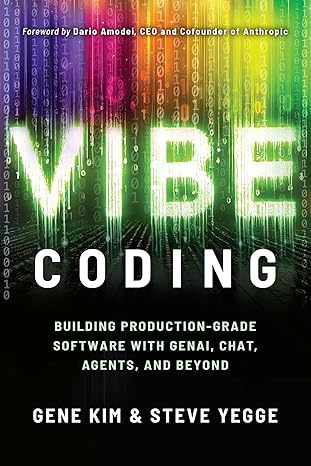
Key Takeaways
-
Agentic coding is not a fad — it’s the next gear shift — Yegge and Kim argue that AI-assisted agentic development is as fundamental a change as moving from assembly language to high-level programming languages. You don’t have to love it. But you do have to reckon with it. Engineers who sit this one out won’t be standing still; they’ll be falling behind while everyone else multiplies their output.
My reaction: I’ve been sceptical of a lot of AI hype over the years, but this framing landed differently. This isn’t “AI will write your code for you.” It’s “AI is now a force multiplier and your value lies in how well you direct and own it.” That I can get behind.
-
The head chef analogy — this is the one — Of all the ideas in the book, this is the one I keep coming back to. You are the head chef. Your AI agents are the sous chefs. They chop, they sauté, they plate — but whatever goes out under your name is your reputation. You can’t blame a sous chef when a dish comes back cold. You hired them, you directed them, you signed off on it leaving the kitchen.
This reframing is genuinely useful. It gives you full permission to delegate aggressively to your agents, and it keeps you 100% accountable for quality. That’s not a burden — that’s leadership, and it’s exactly the mindset shift the book is trying to drive home.
-
Your job changes, it doesn’t disappear — The fear most of us bring to this topic is obvious: am I being replaced? The book’s answer is a firm “no, but.” No — experienced engineers are more valuable than ever as the people who can direct, review, and take ownership of agent output. But your value no longer lives primarily in the code you type. It lives in the judgment you apply to everything the agents produce.
In practice, that means reviewing agent output isn’t optional admin work tacked onto the end of a task. It is the task.
-
Quality is still entirely your problem — The biggest trap the book identifies is treating agent output as “good enough by default.” It isn’t. Agents are fast and often brilliant, but they hallucinate, they over-engineer, and they don’t know your business context. Your job is to catch what they miss. The solution isn’t to distrust your agents — it’s to build the habit of reviewing their output with the same critical eye you’d apply to a junior developer’s PR.
-
Embrace, or get practical fast — The title and premise could easily tip into fearmongering, and I appreciate that Yegge and Kim mostly resist that. They spend more time on how to build an agentic workflow than on dire warnings. There are concrete models here for structuring agent tasks, reviewing output systematically, and gradually shifting the balance between you and the agents as your confidence and tooling matures.
Final Thoughts
Vibe Coding is a must-read for any practising software engineer right now. It’s not always comfortable, but it’s honest — and the head chef framing alone is worth your time. If you’ve read my earlier post on Deep Work, the connection is natural: the focused, high-quality thinking that Cal Newport describes is exactly what separates a head chef who runs the kitchen from one who just hopes it runs itself.
The question the book left me with is the one I’ll leave you with: Are you running your kitchen, or are you still pretending the kitchen hasn’t changed?
Tags: books, ai, agents, vibe-coding, engineering
Get the Book
- Buy on Amazon
- ISBN: 978-1966280026